Posted on 8 Comments

Victory for the Artists! (But the War Isn’t Over)

I’m doing a literal happy dance in the studio today. If you’ve been following my recent (yesterday) saga with the “Tax Man,” I have some fantastic news: I got my tax exemption back with Blick Art Materials!

As it turns out, my gut instinct was right. A “pencil pusher” at the PA Department of Revenue interpreted the laws incorrectly during an audit. They tried to tell Blick that artists aren’t eligible for the resale exemption.

Spoiler alert: That was what we call an “erroneous opinion,” which is the fancy, polite way of saying they were flat-out wrong. Blick Art Materials were also not taking this lying down, and thus there was a battle on two fronts to support the PA artists!

A cartoon character with a bandana and cape, confidently holding a candle while facing a dark, shadowy creature.
My friend Cassie did this illustration of me, I like to get inspired by it when I go to battle.

You might be thinking, “Wait, you just told us about this yesterday! How did you win so quickly?” Well, let me pull back the curtain: I’ve actually been fighting this battle since the end of November. Anyone who knows me knows that when I set my mind on something, I’m like a dog with a bone. I’m incredibly persistent. My strategy is simple: Do at least one thing every single day.

  • Send an email. (A lot of unanswered emails.)
  • Make a phone call. (A lot of long wait times that ended in nothing.)
  • I may or may not have even “ambushed” our local Representative at a New Year’s Eve party. (Hey, if you’re in the neighborhood, you’re fair game!)

So no, this didn’t happen overnight. It was a slow, steady grind of refusing to take “no” for an answer.

A person with short hair is focused on a workbench, using tools and materials for a creative project, surrounded by various art supplies and equipment.
Would you look at that, looks like Klee is “Manufacturing” jewelry.

Upon further review, it was confirmed that artists and creative businesses absolutely can claim the Manufacturing Exemption. Because, hello? We take raw materials and physically transform them into something entirely new. That is the literal definition of manufacturing!

The problem? Our state tax laws are covered in about fifty years of dust. The current “lingo” was written for massive factories with smokestacks, not for the modern wave of small businesses, creatives, and gig workers.

An artist painting a black crow on a colorful canvas while holding a palette with various paint colors in a studio.
Can it be? Am I “actually” creating something new from the materials I buy?

Why I’m Still Fighting

While I won this specific battle, I’m not hanging up my boxing gloves just yet. It shouldn’t take a “war room” corkboard and three months of hounding officials for a creative business to avoid being double-taxed.

I’m going to continue pushing our Representative so that the laws actually reflect the modern market. We need clear guidelines so the next time a pencil pusher feels like making a flippant decision, the law is there to stop them.

Before I go back to making art, I have to say: Thank you to everyone that sent us a comment of support! Seriously, you guys are incredible.

I’ll keep you guys updated. The battle for the “little guy” continues!

Posted on 9 Comments

The “Art Isn’t Real” Tax Fiasco: A Love Letter to the PA Dept. of Revenue

I recently received a piece of mail that made me laugh, then get angry, then consider moving my entire studio to a different planet. It was a letter from Blick Art Materials informing me that the Pennsylvania Department of Revenue has decided that the production of artwork (you know, the thing we do with our lives) does not qualify as “exempt manufacturing” under some dusty statute called 72 P.S. 7201 (c).

UPDATE: WE WON! Read About It Here: https://rafiandklee.com/victory-for-the-artists-but-the-war-isnt-over/

Basically, some pencil-pusher in a cubicle somewhere has decided that when we take raw materials and transform them into something entirely new, we aren’t actually making anything. We’re apparently just… having an expensive hobby? This may have just happened to us, but at this point I’m assuming we are not the only ones dealing with this.

An artist working in a colorful studio filled with art supplies and tools.

How Does The Sales Tax Exemption Work (The Boring-but-Vital Part)

In case you’re unaware of how the grown-up business world is supposed to work: when you are a registered business that manufactures goods, you get a tax break. It’s called a Sales Tax Exemption.

Here’s the deal: If I buy a hunk of clay, paint, canvas, or a gallon of resin to make a sculpture that I then sell, I’m not supposed to pay sales tax on those materials. Why? Because the state gets its cut when the final customer buys the finished piece. If I pay tax on the materials, and the customer pays tax on the statue, the state is double-dipping.

To get this, you usually fill out a form (the REV-1220) and give it to your suppliers (like Blick). It’s a standard system designed to help small businesses actually, you know, stay in business.

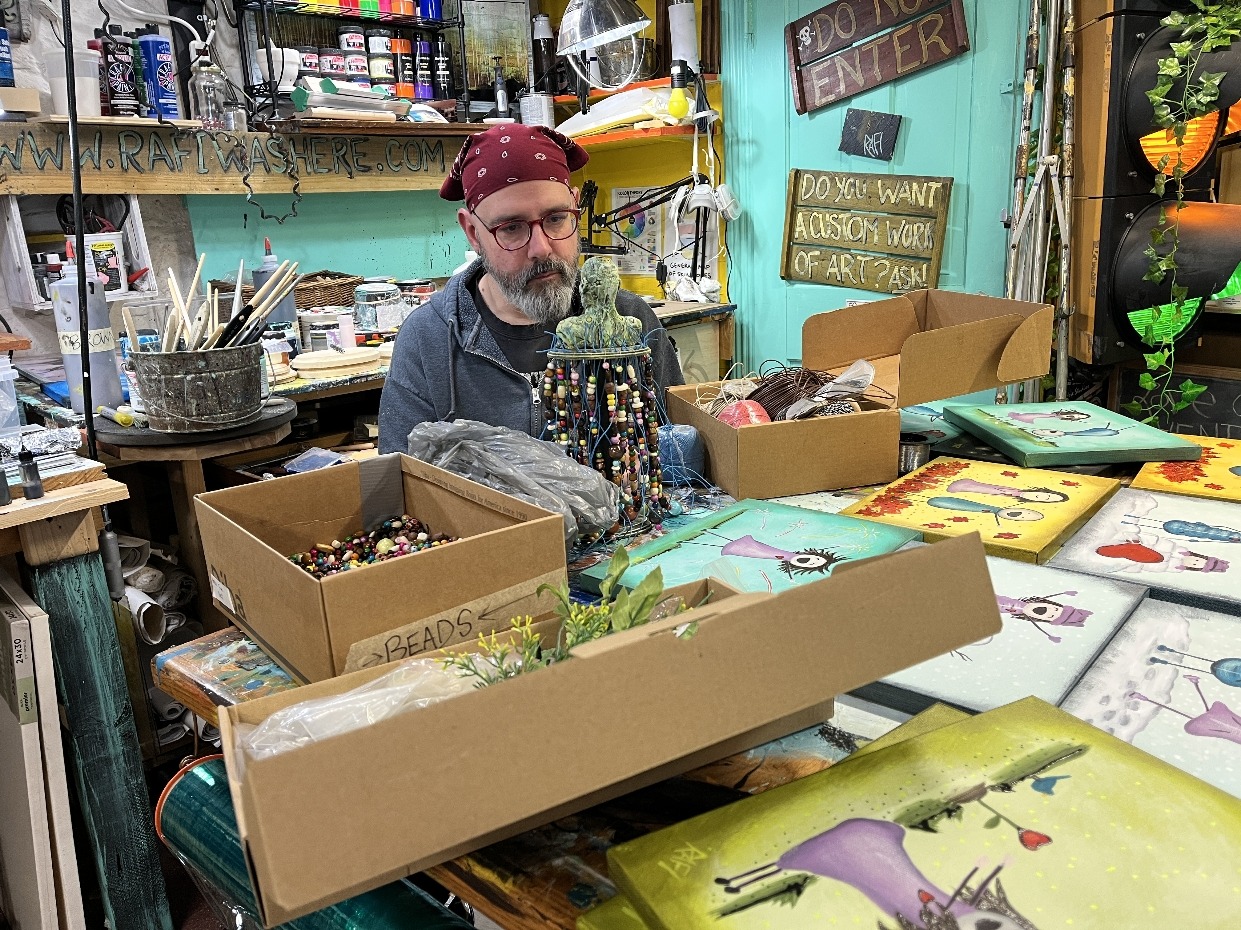
An artist sitting at a cluttered studio workspace filled with art supplies, painted canvases, and boxes labeled 'BEADS' and other crafting materials.

Apparently, Art Supplies Are Not “Raw Material”

We’ve been in business for a while, and I’ve never run into this issue. According to Pennsylvania Department of Revenue, the state doesn’t think art is “manufacturing.” Apparently, they think we just wave a magic wand and the artwork appears. They don’t see the process of creation, or the physical labor of turning a blank canvas into a product. To them, we aren’t “producing goods.”

The core of the problem is that this statute is fundamentally outdated. The lingo used in the current law is written to benefit specific large-scale industries while leaving the door open for interpretations that exclude small businesses and independent makers.

This decision is, to use a technical term, dumb. It directly impacts how I order my materials and how much it costs to keep the lights on in my studio.

A woman stands in an art gallery, looking thoughtfully at the artwork displayed on the walls. She wears a red shirt and beige pants, with a backpack slung over her shoulder.

Standing Up to the Pencil-Pushers

I’m not taking this lying down. I am currently in the process of fighting this at the state level. As artists who run small businesses, we’re often treated like we’re playing pretend. We have to fight twice as hard just to get established systems to recognize our rights as legitimate businesses.

I’m now in communication with my local state representative to make them aware that the Department of Revenue is effectively penalizing the creative economy of Pennsylvania.

Here is my “Rogue Challenge” for you: Whether you use this tax exemption or not, this is about the principle. If the state decides our work isn’t “manufacturing,” they are deciding our work doesn’t have value.

  1. Check your orders. If you’re a registered business, see if you’re being charged tax on your raw supplies.
  2. Contact your State Rep. Seriously. Send a polite but firm email. Tell them that art is manufacturing, that we are businesses, and that this ruling is a blow to local makers.

We have a bit of a road ahead of us to get the “powers that be” to see us as the economic engine we actually are. Sometimes, the only way to get a seat at the table is to stand up and start making some noise.

Banner promoting a local project for artists in Northwest Pennsylvania, featuring playful graphics and the text "ARE YOU A NORTHWEST PA ARTIST? JOIN OUR NEW LOCAL PROJECT FOR ARTISTS IN OUR REGION."

If you live in PA, here is an example letter you can copy, paste and rewrite to suit you:

Subject: URGENT: PA Dept. of Revenue Ruling on Sales Tax Exemption for Artists (Statute 72 P.S. 7201 (c))

Dear Representative [Name],

I am writing to you as a constituent and a small business owner in our region to bring a concerning matter to your attention regarding a recent shift in the Pennsylvania Department of Revenue’s interpretation of tax law.

Recently, the Department has been contacting major art supply vendors (such as Blick Art Materials) to state that the production of artwork no longer qualifies as “exempt manufacturing” under Statute 72 P.S. 7201 (c).

The manufacturing exemption is a standard business practice designed to prevent “double-taxation” by allowing businesses to purchase raw materials—which are then transformed into a new, finished product—without paying sales tax at the point of purchase.

The core of the problem is that this statute is fundamentally outdated. The lingo used in the current law is written to benefit specific large-scale industries while leaving the door open for interpretations that exclude small businesses and independent makers. By ruling that artists are not “manufacturers,” the Department of Revenue is effectively:

  • Invalidating our status as legitimate businesses: It suggests that the physical transformation of raw materials into a finished good only “counts” if it happens in a traditional factory setting.
  • Creating a Double Standard: It allows large corporations to enjoy tax breaks on production while penalizing the small, local studios that make up the backbone of the creative economy in regions like ours in PA.
  • Increasing Overhead Costs: This interpretation forces double-taxation on our materials, making it even harder for local makers to remain competitive.

The process of creating a sculpture, a piece of jewelry, or a painting is a physical transformation of raw materials into a manufactured good. I ask for your support in advocating for a modernized interpretation of this statute—one that recognizes the reality of 21st-century small business and ensures that “manufacturing” isn’t a term reserved only for big industry.

We are taxpayers, business owners, and vital contributors to the economic and cultural vitality of this district. I look forward to hearing your thoughts on how we can resolve this issue.

Sincerely,

[Your Name] [Your Business Name] [Your Address] [Your Phone Number]